



Lately, many people have been asking:
“I want to work in Singapore, but I have no idea where to start with applying for an EP. Is there any shortcut?”
“I’ve heard that EP applications are getting harder. Do I really need a high salary and high qualifications?”
“I’ve heard that Singapore’s COMPASS scoring system is very complicated. How should I prepare?”
Questions like these come up every day.
Many foreign professionals focus on simply “landing a job,” yet they overlook the fact that the EP application itself is the crucial first step to working in Singapore. The EP not only determines whether you can legally work in Singapore, but also lays the foundation for future PR applications, career development, and long-term life in the country.
Today, we’ll take you through everything from scratch: a systematic guide to EP scoring criteria, application process, and key points to watch out for—helping you confidently secure this “entry pass.”
EP: Your “Entry Pass” to Working in Singapore
The EP (Employment Pass) is an essential permit for foreign professionals, managers, and executives to work legally in Singapore. It not only allows you to work and live stably in Singapore, but also lays the foundation for future PR applications.
It’s important to note that the EP application requirements are no longer as straightforward as they used to be. To assess the overall value of foreign talent more systematically, the Ministry of Manpower (MOM) introduced a new COMPASS (Complementarity Assessment Framework) on 1 September 2023.
This means that future EP approvals will no longer focus solely on salary. Instead, multiple factors—including educational qualifications, company contributions, and the scarcity of skills in the industry—will be taken into account.
In other words, obtaining an EP is no longer a “single-point breakthrough”; you need to demonstrate your competitiveness across multiple dimensions.
What are the assessment criteria of COMPASS?
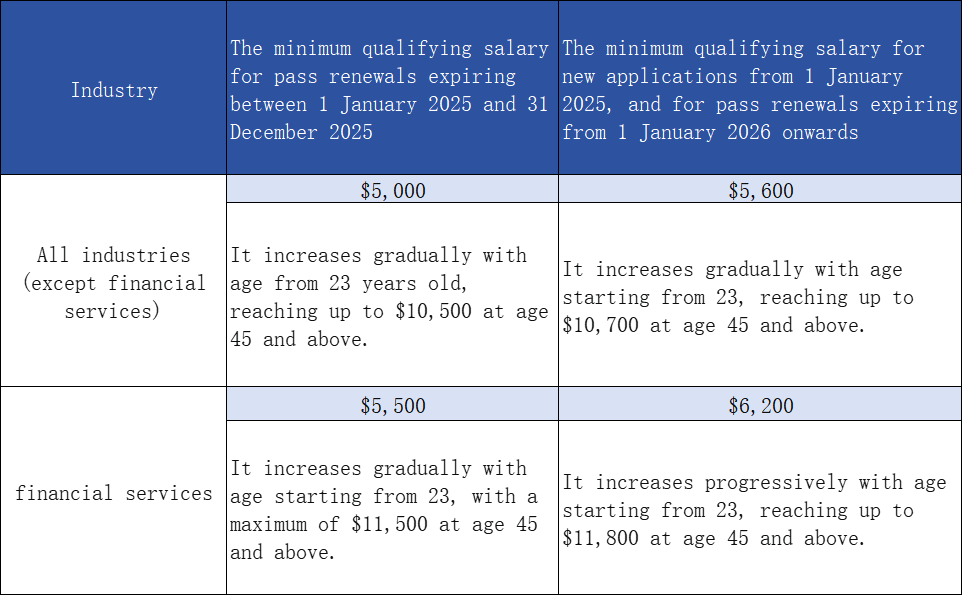
Step 1: Meet the Salary Requirement
Step 2: Pass the Complementarity Assessment Framework (COMPASS)
Applicants will be scored by the Ministry of Manpower (MOM) based on four core criteria and two bonus criteria.
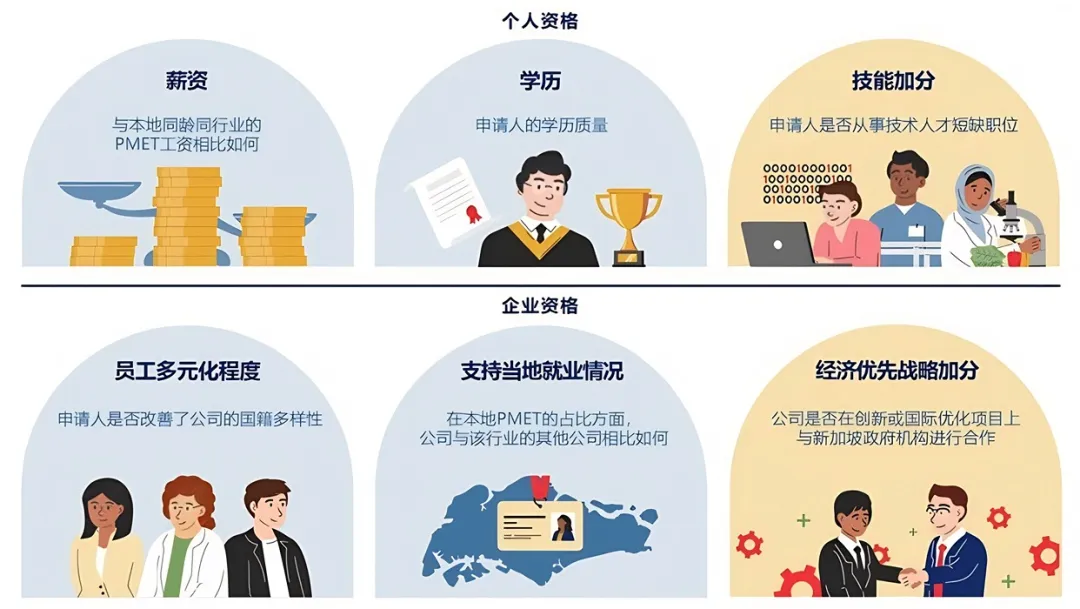
Applicants will be assessed for eligibility by the Ministry of Manpower (MOM) based on the table above. In addition, applicants must score at least 40 points to qualify for an Employment Pass. The scoring rules are as follows:
PMET: Professionals, Managers, Executives, and Technicians
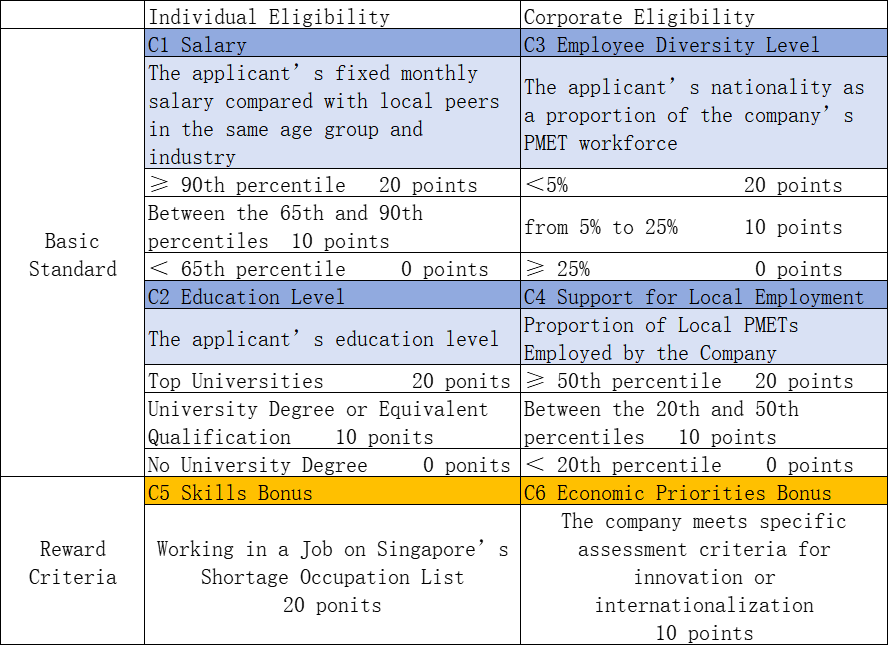
- Small companies employing fewer than 25 PMETs automatically receive 10 points in C3 and C4.
- Companies with a proportion of local PMET employees reaching 70% can receive at least 10 points in C3.
- If a candidate’s nationality accounts for one-third or more of the company’s PMET workforce, the skills bonus will be reduced to 10 points.
Key Points for Application:
- Ensure your salary meets the requirement; you can use the MOM Self-Assessment Tool (SAT) to calculate it.
- Prepare complete educational and employment documentation.
- Choose a compliant employer with strong support capabilities.
- For SMEs, you can improve your score by optimizing the employment structure.
What is the process for applying for an EP?
Eligibility Confirmation
The employer uses the Self-Assessment Tool (SAT) to evaluate the applicant’s eligibility based on education, work experience, and salary to confirm whether they meet the basic requirements for an EP.
Preparing Application Documents
This includes the EP application form, passport copy, national ID copy (for China), and an education verification report recognized by the Ministry of Manpower (MOM) of Singapore, among other documents.
Submitting the Application
The employer submits the EP application through MOM’s electronic system.
Review and Approval
Each EP application is assessed on a case-by-case basis, so processing times may vary—from a few working days to a month. Therefore, it is crucial to prepare all required documents in advance. During this period, MOM may request additional checks or supplementary information.
Receiving Approval
Once approved, the applicant will receive an In-Principle Approval (IPA) Letter, valid for six months. The applicant must enter Singapore within this period and complete the EP card issuance process for the EP to take effect.
Obtaining the EP Card
After card issuance, the applicant will undergo fingerprinting and photo submission. The physical EP card will be issued within a few working days.
What are the pitfalls to avoid in an EP application?

During the EP application process, many applicants tend to fall into common pitfalls, which can lead to delays or even rejections. Key reminders are as follows:
Mismatch Between Position and Background
Applying for a role that does not match your qualifications or experience just to quickly secure an EP may raise concerns with MOM about job stability.
Salary Inconsistency with Tax Records
Declaring a higher salary to meet EP requirements, but receiving a different actual salary after employment, can negatively affect your credibility.
Incomplete or Contradictory Documents
Resumes, education certificates, work experience, and passport information must be consistent. Any discrepancies are likely to be scrutinized.
Company Qualifications or Size Not Meeting Requirements
The company’s industry, size, and financial status can affect EP approval. Choosing a legitimate and compliant employer is safer.
Neglecting Long-Term Planning
The EP serves as the foundation for long-term career development and future PR applications. From the start of employment, it is important to maintain continuous tax compliance, stable work history, and integration into the workplace and community.
Avoiding these pitfalls can improve your chances of a successful application and support long-term residency planning.
PR: Transitioning from Short-Term to Long-Term Status
Obtaining an EP is just the first step. Many applicants choose to apply for PR (Permanent Residency) after working and living in Singapore for a period of time.
In theory, there is no strict requirement for the interval between obtaining an EP and applying for PR. However, in most successful cases, applicants apply after holding an EP for more than two years.
This period allows you to build:
- Tax and Economic Contribution: A continuous tax record strengthens your case.
- Proof of Residence and Living: Demonstrates that you are genuinely living in Singapore long-term.
- Social Integration: Shows a more complete professional and social network.
In short, immigration officers are looking for long-term residents who are genuinely integrated, not short-term visitors.
SIG Global:Making EP Applications Simple
Applying for an EP or PR is not as simple as “submitting a form once.” It involves employer eligibility, document preparation, COMPASS scoring optimization, and long-term planning. Many applicants are rejected due to overlooked details, delaying their overall plans.
At The Solutions Space, we have extensive experience in Singapore work pass applications:
- Familiar with the COMPASS framework, helping clients optimize scores accurately;
- Assisting companies in improving employment structures to increase approval rates;
- Providing end-to-end application services to ensure document compliance;
- Designing long-term residency and asset planning strategies for clients.
We always emphasize:
Secure your EP first—it is the safest and most practical first step.
Every person who successfully obtains an EP is not relying on last-minute efforts. It is the result of careful planning and steady progress. By proactively planning each step—from preparing documents to long-term strategy—you can ensure a smoother path for future development.
Related Resources
No results found.