


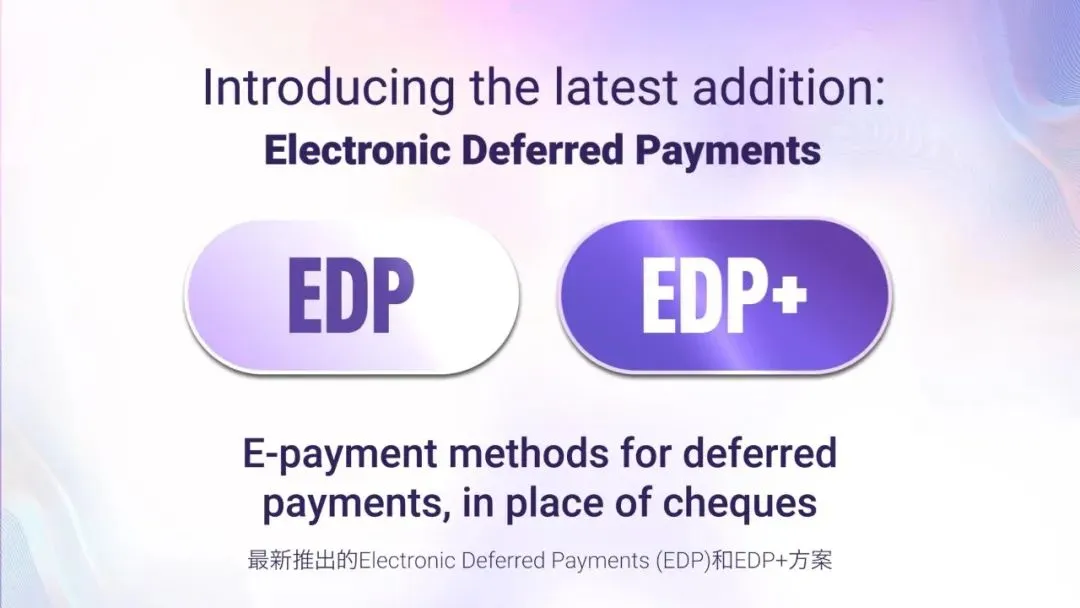
Starting from 2026, companies in Singapore will no longer be able to issue new local corporate cheques (SGD corporate cheques). By 2027, the processing of all local corporate cheques will be completely discontinued. Replacing them are two new tools—EDP and EDP+—introduced by the Association of Banks in Singapore (ABS) in collaboration with the Monetary Authority of Singapore (MAS), positioned as “electronic deferred payment” solutions.
As of July 28, EDP and EDP+ services are available through the digital banking platforms of seven participating banks.
The phase-out of cheques is now officially scheduled: Corporate finance in Singapore enters a paperless countdown

Starting from January 1, 2026, all banks in Singapore will cease the issuance of new SGD corporate cheque books.
By January 1, 2027, all banks will stop processing SGD corporate cheques entirely.
This transition is not abrupt but has been years in the making, driven by several clear trends:
- Sharp Decline in Cheque Usage and Rising Clearing Costs
According to data provided by the Association of Banks in Singapore (ABS) to Lianhe Zaobao, the volume of SGD cheque transactions has plummeted from 61 million in 2016 to around 14 million in 2023—a drop of nearly 80%.
At the same time, cheques’ share of all payment methods fell from 32% in 2016 to under 4% in 2023.
Meanwhile, the cost of clearing a single cheque has tripled over the same period, highlighting how the traditional cheque system no longer meets modern business demands for speed and cost-efficiency.
- Widespread Adoption of Electronic Payment Tools
With the broad use of digital payment platforms such as PayNow, FAST, and GIRO, the frequency of cheque usage has drastically declined. The “presence” of cheques in corporate finance is rapidly diminishing, and the marginal cost of maintaining the cheque clearing infrastructure has significantly increased as a result.
- Global Movement Toward Phasing Out Paper Cheques
Singapore’s initiative aligns with global trends, including the U.S. federal government’s plan to eliminate paper cheques by September 30, 2025. This move is expected to save the U.S. Treasury approximately USD 750 million, reinforcing the shift toward fully digital financial systems.
EDP and EDP+: Purpose-Built for Deferred Payments and Refundable Deposits
EDP and EDP+ complement existing electronic payment methods such as PayNow, Fast and Secure Transfers (FAST), GIRO, and the Monetary Authority of Singapore’s MEPS+ system.
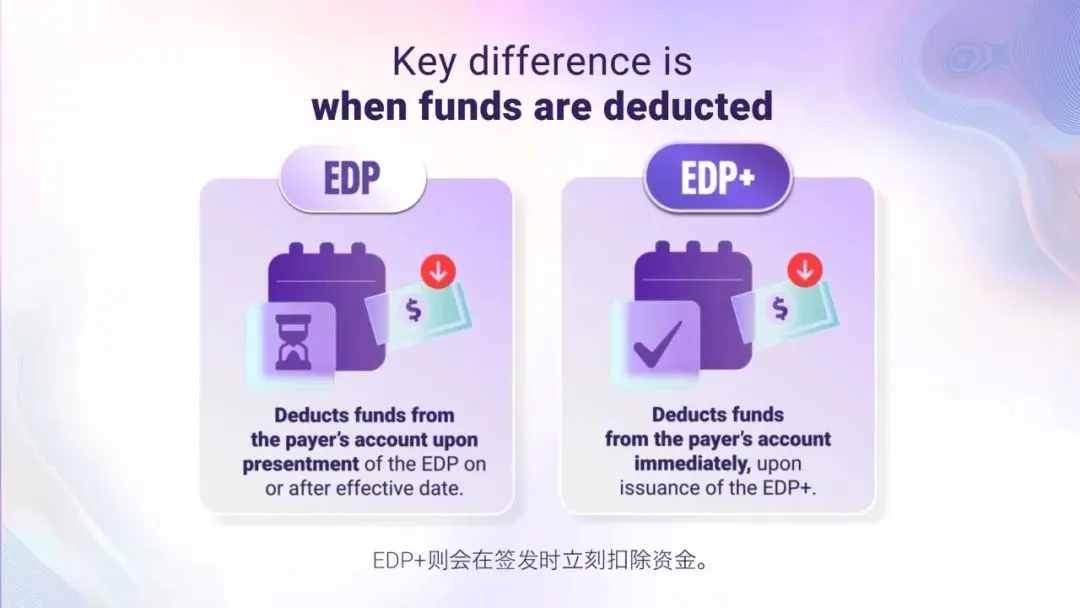
While FAST and PayNow are designed for instant or same-day transactions, EDP and EDP+ are specifically tailored for payments that require deferred settlement or involve refundable deposits.The key distinction lies in the timing of fund deduction—this fundamental difference directly determines their respective use cases.
The “Deferred Deduction” Mechanism of the EDP Scheme
EDP operates on a “payee-initiated deduction” mechanism, meaning that funds are only deducted from the payer’s account when the payee sends a request for payment. This model closely replicates the core logic of traditional cheques—separating the payment commitment from the actual deduction.
For businesses that prioritize cash flow management, this design allows funds to remain available for other operational or investment activities during the commitment period, thereby enhancing capital efficiency.
EDP is suitable for the following typical scenarios:
- Supplier payments
- Project bid security deposits
- Property purchase option fees
These types of transactions typically involve a longer confirmation cycle. In the past, businesses often used post-dated cheques to gain a financial buffer. EDP can be viewed as the digital successor to that practice.
The “Instant Fund Freeze” Mechanism of the EDP+ Scheme
EDP+ offers a more secure and deterministic payment assurance method. At the moment an EDP+ is created, funds are immediately deducted from the payer’s account and frozen, ensuring that the amount cannot be used for other transactions. This guarantees the reliability and irrevocability of the payment.
This mechanism fundamentally addresses the risk of failed payments due to insufficient funds—a common issue with traditional cheques at the clearing stage—providing the payee with a much higher level of financial security.
EDP+ is particularly suitable for high-risk or high-value scenarios such as:
- Payment of large property transaction deposits
- Performance bonds for major contracts
In such cases, the payee’s need for certainty and immediate fund locking far outweighs the payer’s need for liquidity. EDP+ thus offers a robust and fully digital solution with guaranteed payment assurance.
According to a media release by the Association of Banks in Singapore (ABS) on July 28, EDP and EDP+ services are now available via the digital banking platforms of seven participating banks:
Citibank Singapore, DBS Bank, HSBC, Maybank, OCBC, Standard Chartered, and UOB.

Users can make transfers using a mobile number, NRIC number, Unique Entity Number (UEN), or bank account number, and both payer and payee will receive real-time notifications of the transaction. If you are already using the digital banking services of any of the seven participating banks, no separate registration is required.
*Currently, EDP and EDP+ services are available only within Singapore and for payments made in Singapore Dollars (SGD). Individuals and businesses can still continue to use USD cheques as usual.
Don’t Wait for the Cheque Phase-Out to Upgrade: Overseas Businesses Must Plan Ahead
Chinese enterprises setting up operations in Singapore often rely on familiar financial systems from their home country or other regions—many of which still depend on paper cheques for payments or payment confirmation.
Once cheques are phased out, these businesses will face immediate risks:
- Existing approval and payment delay mechanisms will become invalid, leading to cash flow forecasting errors;
- Traditional payment processes may no longer be compatible, causing financial system lag;
- Poor integration with banks’ electronic platforms may reduce transaction efficiency.
Conclusion
At the early stages of company registration and establishment, SIG global advises businesses to proactively embrace the trend toward digitalization. Priority should be given to selecting payment tools compatible with local banking systems, driving the transformation of financial processes toward a “cheque-free” model, and adopting electronic payment solutions such as EDP and EDP+ as early as possible. At the same time, it is essential to update payment agreements with customers and suppliers accordingly to ensure consistent operations and to mitigate risks of process disruptions or compliance issues later on.
Related Resources
No results found.